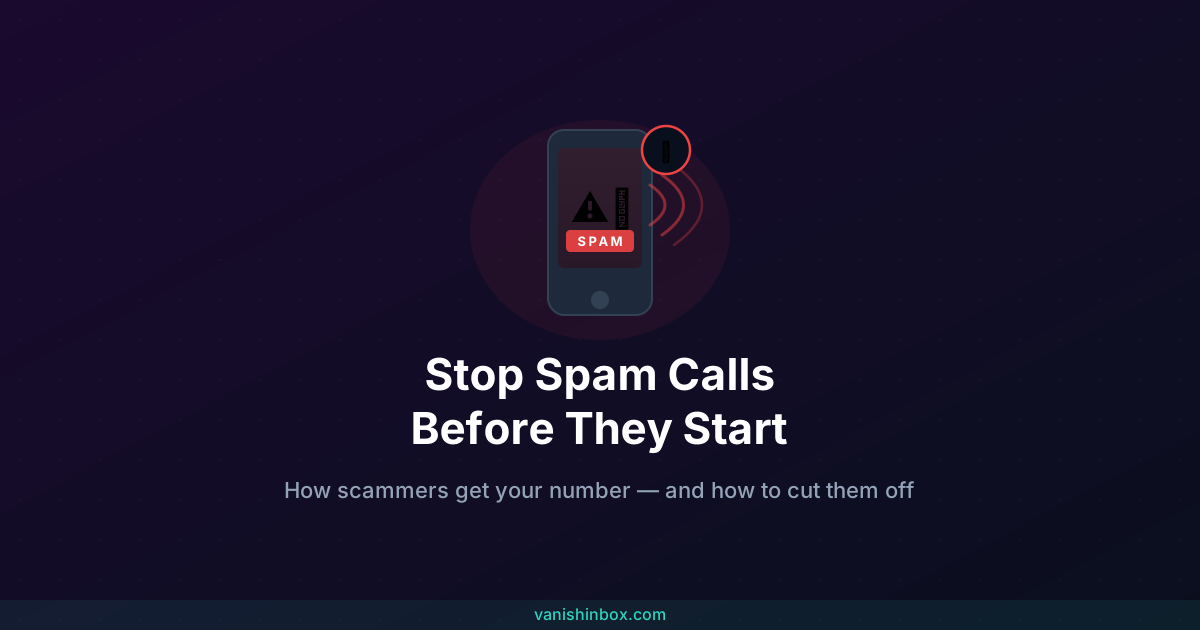
You pick up the phone. An urgent voice tells you there's a breach of contract, a lawsuit pending, or an outstanding debt that needs to be settled immediately — by gift card or cryptocurrency, of course. The caller says they're from United Client Solutions.
If that name is why you're here, you're not alone. These calls have picked up sharply, and the pattern is consistent enough now that it's well-documented across consumer complaint boards, carrier spam databases, and fraud forums: an aggressive script, a fake debt, and a demand for payment that no real collector would ever make over the phone. This guide covers what United Client Solutions calls actually are, how to shut them down, and — the part most guides skip — how your number ended up in their hands in the first place.
Is United Client Solutions a Scam?
Mostly, yes — but the honest answer has a wrinkle worth knowing. A business registered under the name United Client Solutions does exist. That's part of what makes these calls effective: borrowing or spoofing a real, findable name gives an otherwise obvious scam a layer of surface credibility that a fully made-up company name wouldn't have.
What lands on consumer complaint sites and scam-tracking forums under that name is a mix of two things. Some callers are spoofing the name entirely — nothing ties them to any real entity, they're just using it as a mask. Others may be aggressive third-party debt collectors who bought a debt file, sometimes for a debt that's expired, disputed, or not actually owed, and are using tactics that cross into illegal territory: threatening arrest, demanding untraceable payment, refusing to send written proof. Practically, the distinction doesn't matter much for what you should do. A legitimate collector — real name or not — is legally required to validate the debt in writing before pursuing payment. Any caller who skips that step and pushes for immediate payment by phone is operating outside the law, whatever name is on their script.
How the Scam Works
These calls follow a predictable script. The caller:
- Opens with urgent legal or financial language ("lawsuit", "arrest warrant", "credit consequences")
- Drops a partial piece of personal information — your surname, a partial account number — to seem credible
- Demands immediate payment through an untraceable method: gift cards, crypto, wire transfer
- Discourages you from contacting your bank, a lawyer, or any third party
- Hangs up and calls back repeatedly if you don't comply
The partial personal detail is a key trick. It doesn't mean they know anything real — it means they bought a data list that included your name next to your phone number. When you press for verifiable account details, they stall or invent them.
What to Say (and Not Say)
The safest response is the shortest one. If you answer and suspect it's a scam:
What to do:
- Say "I'm disputing this debt. Send me a written Validation Notice by post." Then hang up.
- Note the number, time, and what the caller said.
- Block the number immediately.
What not to do:
- Never confirm personal details, even to "verify" your identity.
- Never pay by gift card, crypto, or wire transfer for any debt — no legitimate collector uses these.
- Don't stay on the line to argue. Engaging keeps you on their list as an "active" contact.
The script that works: "I dispute this debt. Under the FDCPA you are required to send written validation before I take any action. Do not call again." Then end the call.
Why AI Makes These Calls More Convincing
Older robocalls were easy to identify — robotic voices, awkward pauses, obvious scripts. That's changed. Cheap voice-synthesis tools now let scammers run calls that sound natural, respond to your questions, and adapt mid-conversation.
Signs you're talking to an AI caller:
- Unusually smooth but oddly phrased responses
- Short, evasive answers when you ask for specific account details
- The caller repeats the same short phrase slightly differently
- There's no real pause when it "listens"
This doesn't change what you should do — hang up and block — but it explains why these calls feel harder to dismiss than they used to.
How to Block United Client Solutions and Similar Spam Calls
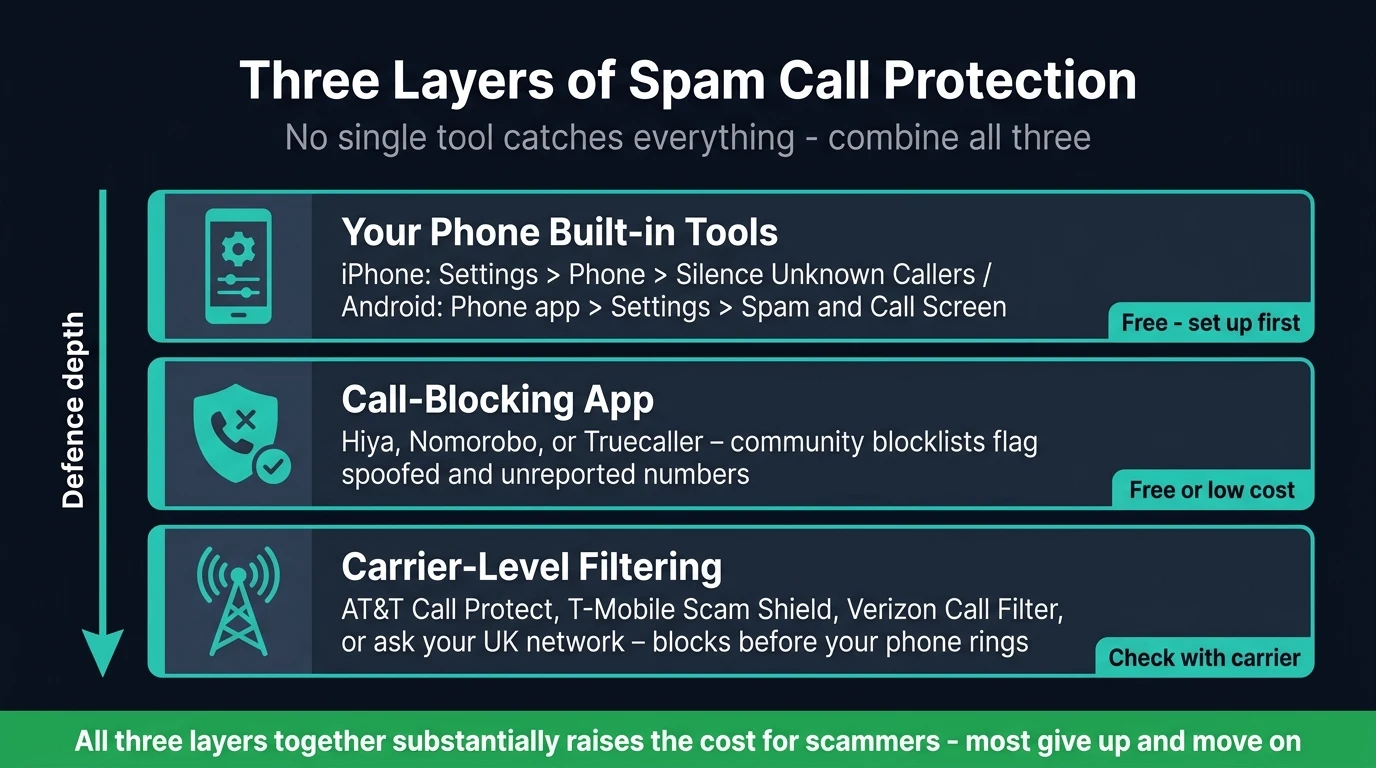
Blocking works best in layers. No single tool catches everything, so combining them is the right approach.
Layer 1 — Your phone's built-in tools
Both iOS and Android let you silence unknown callers or label likely spam. Enable these first:
- iPhone: Settings → Phone → Silence Unknown Callers
- Android: Phone app → Settings → Spam and Call Screen
These are free, quick to set up, and filter a large chunk of robocalls at source.
Layer 2 — A call-blocking app
Apps like Hiya, Nomorobo, or Truecaller add community-reported blocklists and catch numbers that haven't been individually reported yet. They're particularly good at flagging spoofed numbers — calls that show up under a local-looking number but originate elsewhere.
Layer 3 — Your carrier's filtering
Most UK and US carriers offer network-level spam filtering, often for free or a small monthly fee. This blocks calls before they even reach your phone. In the UK, check with your network provider. In the US, AT&T Call Protect, T-Mobile Scam Shield, and Verizon Call Filter are worth enabling.
Using all three layers substantially raises the cost for scammers and lowers the chance any call gets through.
How to Report Scam Calls
Reporting matters — it feeds into enforcement databases that carriers and regulators use to shut down call campaigns. Here's where to report:
In the UK:
- Ofcom: ofcom.org.uk
- Action Fraud: actionfraud.police.uk — for calls where money changed hands or personal data was taken
- Your mobile carrier's spam reporting line (usually free to text the number to 7726 in the UK)
In the US:
- FTC: reportfraud.ftc.gov
- FCC: fcc.gov/consumers/guides/filing-informal-complaint
- Your carrier's fraud line
When reporting, have ready: the date and time of the call, the number shown, and a brief note on what was said. If any money moved or identity information was shared, escalate to your local police and place a fraud alert with the credit agencies.
How Your Number Got on the United Client Solutions Call List
Most people assume scammers cold-call random numbers. That's rarely how it works. The more efficient approach — and the one scammers prefer — is to buy lists.
Here's the typical chain:
- You sign up to a website using your real email address
- That site sells its user data to a data broker
- The broker enriches the record — linking your email to your name, address, and phone number using data from other sources
- That enriched record is sold again, to marketers and eventually to fraudsters
- The fraudster now has a list of real names and phone numbers, complete enough to sound credible on a call
This is why scam calls often include a personal detail — your surname, your town. They didn't find it by hacking you. They bought it.
The Email Connection Most People Miss
Email is usually the starting point. Your primary email address is often tied to account recovery, transaction alerts, and billing records — all of which make it easy to verify and enrich with other data. When a site breaches or sells its email list, your address enters a data pipeline that frequently ends with a phone call.
The practical fix is to stop your primary email from entering that pipeline in the first place. Use a disposable email address — one that expires after use — for any sign-up you're uncertain about. Free trials, newsletters, competition entries, discount sites: all of these are common data sources for the broker ecosystem.
VanishInbox generates a working temporary inbox instantly, with no sign-up required. Use it for any site you're not sure about. When the address expires after 10 minutes, whatever list it's on becomes a dead end. For more on how this protects you, see what actually happens when a website sells your email address.
A Practical Ongoing Routine
Dealing with scam calls isn't a one-time fix — it's a habit. This routine keeps your exposure low:
- Use a disposable email for any sign-up you're not committed to. This is the single highest-impact step.
- Enable silent/spam mode on your phone so unknown callers go to voicemail.
- Block and report every scam call. Don't engage, don't argue, don't hang on to see what happens.
- Audit your accounts occasionally — close services you no longer use to shrink the number of places holding your details.
- Never pay by gift card or crypto for a "debt". No legitimate organisation does this. Ever.
If you want a broader look at protecting your email identity — which is usually where phone scams start — see the one rule that keeps your inbox permanently clean.
Frequently Asked Questions
How do I stop United Client Solutions from calling me?
Don't engage beyond the validation-notice script covered earlier. Block the number immediately after the call, but expect a new one next time — these operations rotate through spoofed numbers, so blocking one number rarely stops the campaign. Layered call-blocking (covered earlier in this guide) does more than blocking individual numbers one at a time.
Why does the caller know my name?
Most likely because your details appear in a purchased data list. This doesn't mean the caller knows anything else specific — it means they bought a record that linked your name to your phone number, often via a data broker who compiled it from various online sources.
Should I answer to tell them to stop calling?
No. Answering and engaging — even to complain — confirms your number is active and monitored. This makes you more valuable on their list, not less. Let unknown calls go to voicemail, and block the number afterwards.
Can I stop my number from being on these lists entirely?
Completely eliminating your number from all lists is very difficult once it's there. But you can stop adding to the problem. Use disposable email for untrusted sign-ups, opt out of data broker lists (services like DeleteMe or Privacy Bee can help), and avoid entering your phone number on forms that don't strictly need it.
What if I already gave them money or personal information?
Contact your bank immediately if payment was made. If personal information like your National Insurance number (UK) or Social Security number (US) was shared, place a fraud alert with the credit agencies — Experian, Equifax, TransUnion. Then report to Action Fraud (UK) or the FTC (US) as soon as possible.
Should I call back the number United Client Solutions left on voicemail?
No. Calling back confirms the number is active and connects you straight back to the same script, on their terms. If you want to dispute the debt, do it in writing by post as covered above — never by calling a number the caller gave you.
Where do I report a United Client Solutions call specifically?
The same channels as any scam call: the FTC at reportfraud.ftc.gov and your carrier's spam line in the US, or Ofcom and Action Fraud in the UK. Name the company in your report — regulators and carriers use these reports to build a pattern against recurring campaigns, and specificity helps.